|
|
AGORA 2.0
How tightly connected the history of the Baltic Sea countries is, can be visible in the cooperation of Narva, Hame and Skokloster. In the mid-17th century when Swedish kingdom had no rivals in the region, one of its most influential noblemen Carl Gustaf Wrangel began to build a new castle by the lake Malaren in Skokloster, where he was born. Herman Wrangel, the father of Carl Gustav was a Baltic German noble who had a successful career in Swedish army and court and who also owned land in Estonia. In 1612 he participated in the siege of Ivangorod fortress and after the successful conquest became its commandant. After the death of Carl Gustaf Wrangel in 1679 his oldest daughter Margareta Juliana inherited Skokloster castle. She married a high nobleman Nils Nilsson Brahe, whose uncle Per Brahe gave Hame town rights in 1639.
Situated between Stockholm and Uppsala near the lake Maralen baroque-style Skokloster Castle was built in 1654-1676 by order of count Carl Gustaf Wrangel and from the design by architect Nicodemus Tessin Vanema. After Wrangel's death the ownership of the castle was passed on to Brahe family and in the 20th century to von Essens family. From 1967 the castle belongs to the Swedish state and is open as a museum. By the fideicommiss act of 1701 taking away any items from the castle is forbidden. Thanks to such a restriction Skokloster owns a unique in Europe 17th century interior and items collection.
Hame Castle is situated 100 km north from Helsinki, and assumed to be constructed in the end of the 13th century in order to perpetuate the Swedish conquest of the Finnish territory by Swedish jarl Birger Magnusson. In the Middle Ages the initial castle was rebuilt to accommodate a representative of the Swedish king, in the 18th century a third floor was added and bastions with moat encircled the castle. From 1837 till 1972 the castle was a prison. Now it is a museum and one of its expositions „Terra Tavestorum“ introduces the Hame's history.
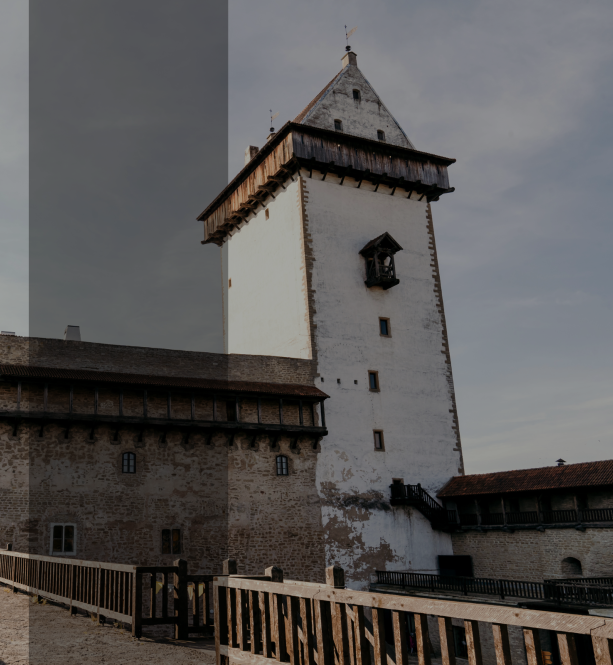
Located on the bank of the Narva river on the eastern Estonian and EU border Narva Castle was established by Danes at the end of the 13th c. In the mid-14th c. Livonian Order acquired the castle and in the next two centuries rebuilt it into a strong convent buildling with enforced Herman tower and outer walls. Modern castle mostly maintained its appearance from that period. Inside, the Narva museum presents the town and castle history. In summer period in the northern yard the historical and craftsmen center „Northern Yard“ introduces the Early Modern Period, which is perceived as the Golden Ages in the town history.
Map of the Baltic Sea Region
|
|